Spectral methods and Function bases
Most problems have complex domains.
Boundary conditions crucial.
Little “structure” to problem.
What use is “structure” in the grid?
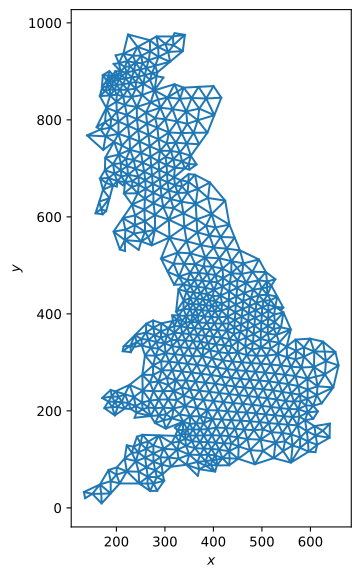
Use unstructured grids.
But how, whilst keeping accuracy?
A Fourier Series
\[ \phi = \sum_n c_n(t) \chi_n(x) = \sum_{n=-N}^N c_n(t) \exp(\mathrm{i} n x) \]
allow us to compute eg \(\partial_x \phi\) everywhere.
Extend to more complex bases \(\chi_n(x)\) to
How does finite \(\{\chi_n \colon n=0,\dots,N\}\) best match solution to
\[ \partial_t \phi + F(\phi) = 0? \]
Case 1: match at points \(x_j\) (colocation).
\[ c_n \chi_n(x_j)=\phi(x_j), \quad \forall x_j, \quad j=0,\dots,N. \]
Gives linear system for \(c_n\).
Case 2: minimise residual \(R(\phi)=\partial_t \phi+F(\phi)\) wrt basis (Galerkin).
\[ \int R(\phi) \chi_m(x) = 0, \quad \forall m = 0, \dots, N. \]
Galerkin methods best “on average”. PDE
\[ \partial_t \phi+F(\phi)=0 \]
becomes, for \(\phi = \sum c_n(t) \chi_n(x)\),
\[ \begin{aligned} \sum_n I_{nk} \frac{\mathrm{d} c_n}{\mathrm{d} t} &= - \int F \left( \sum_n c_n \chi_n \right) \chi_k, \quad \forall k, \\ I_{nk} &= \int \chi_n \chi_k \, . \end{aligned} \]
Coupled nonlinear ODEs.
![A spectral method advects the initial data $\sin^4(2 \pi x)$ around the domain $x \in [0, 1]$ up to $t = 0.5$. Fourier modes $c_n = -N, \dots, N$ are used. Spectral (exponential) convergence with the number of modes is seen. It is also clear that this is much faster than first or second order convergence as indicated on the bottom panel.](lecture_spectral_files/figure-revealjs/cell-3-output-1.svg)